
Calendar of Events
Tom Farris: alterNative Closing Reception
October 22 @ 4:00 pm - 6:00 pm
Free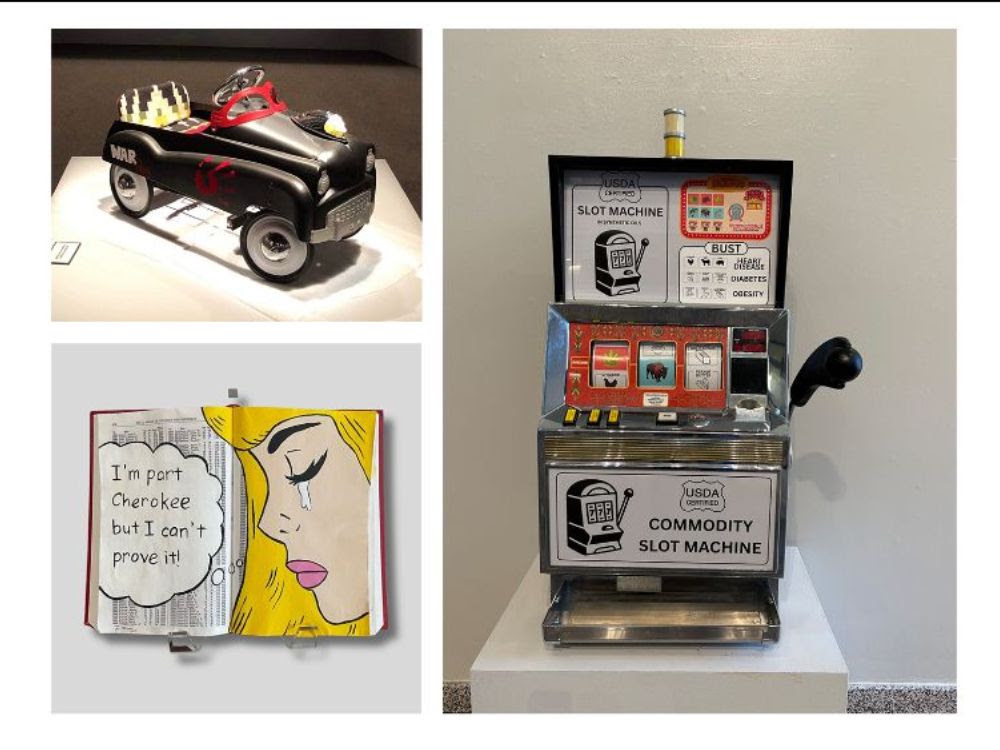
Tom Farris: alterNative
Dates: September 15 – October 22, 2026
Closing Reception: Thursday, October 22, 4:00-6:00pm
Visiting Artist Workshop: Wednesday, October 21, 1:00-3:00pm in CADE 310
Join us for the Cade Gallery’s fall exhibition, “Tom Farris: alterNative,” featuring the work of Cherokee and Otoe-Missouria artist Tom Farris. This one-person exhibition includes work in a variety of media—digital prints, sculpture, paintings, view masters, and found object sculptures—from throughout Farris’s decades-long career. The overarching themes of Farris’s work have remained consistent throughout. Whether in his pedal car My First War Pony, the Star Wars-inspired When the Sith Hits the Fan, a Roy Lichtenstein inspired blonde woman with a familiar thought bubble that reads I’m Part Cherokee, but Can’t Prove It, or his Instant Ledger Art-o-Matic that projects View Master images on ledger paper, Farris is equally concerned with “all things popular culture” as he is with American Indian art, stereotypes, and representing his cultural identity as a member of the Cherokee Nation and the Otoe-Missouria tribe.
Farris’s work is deceptively easy to take in, with its references to Superman, Batman, Star Wars, View Masters, slot machines, and skateboards. On closer look, however, those pop culture references are filtered through Farris’s background in American Indian art and his personal and cultural identity. For example, Cherokee syllabary, developed to ensure the continuation of the Cherokee Nation’s language, makes a frequent appearance in Farris’s artwork. In his graphic and boldly colored Indigenized Superman (who wears the typical Superman colors and costume), the figure’s short hair is now long and the “S” Superman logo, now appears as the Cherokee character for “S.” Similarly, his painting of the Batman logo is now emblazed with the Cherokee word for “Batman.”
In other works, Farris references Ledger art, so-called because the works were drawn on lined ledger paper. Ledger art was popular in the nineteenth century, the time of mass removals, allowing many Native people to document their history on their own terms. His view master work, Instant Ledger Art-o-Matic, includes a 1930s View Master projector which projects his artworks onto a small sheet of ledger paper, thus creating “instant ledger art.”
That Lichtenstein inspired blonde with her thought bubble, “I’m Part Cherokee, but Can’t Prove It,” appears, on closer inspection, on the pages of a bound book, a first edition of the Dawes Rolls. The Dawes Act allowed the President to break up reservation lands for allotment of land parcels to the Five Civilized Tribes. The Rolls included both those approved for land allotment and those disapproved or rejected. The blonde woman references those individuals who were “Part Cherokee,” but because they could not prove it, were rejected from the rolls and thus from allotment.
A recent work, Culture Over Commodity, addresses food sovereignty and the deleterious effects of introducing mass produced food, some “in synthetic oils” to Native people. The slot machine turned sculpture asks players to spin the wheels in the hopes of winning the jackpot, which requires the highly unlikely alignment of several brightly colored squares with such pre-contact foods as fish, bison, deer, and the “three sisters,” corn, beans, and squash. The much more likely “bust” promises “heart disease,” “diabetes,” or “obesity.” Hitting the jackpot in this instance results not in a monetary prize, but in the promise of a return to “pre-contact” food sources, like heirloom corn varieties, which rest in the tray at the base of the slot machine. This tension between the popular and the deeply damaging history of Settler Colonialism are at the heart of Farris’s work, as he takes on subjects around Tribal and food sovereignty, resilience, and survivance, while also battling longstanding stereotypes and myths that continually undermine those efforts. Missing Link is a white satin sash that reads “Cherokee Princess 1878.” It might, as the text suggests, have been used by a Cherokee Princess in 1878. Trouble is, there were no Cherokee princesses. Farris, with a tinge of irony and humor so prevalent in his work, turns the stereotype on its head. The joke, it seems, is on us.
Join us on Wednesday, October 21, for a Visiting Artist Workshop, and Thursday, October 22, for a closing reception and remarks from the artist.
Image Identifications:
Tom Farris
Culture Over Commodity
Mixed media
2026
Tom Farris
I’m Part Cherokee!
Mixed media
2016
Tom Farris
My First War Pony
Mixed media
2017
VISIT THE GALLERY: Monday-Thursday, 8:30 a.m.–4:30 p.m.
The Cade Center for Fine Arts Gallery is on Anne Arundel Community College’s Arnold campus at 101 College Parkway. Located on the main floor of the Cade building on West Campus, the Cade Art Gallery features five exhibitions a year. The span of exhibiting artists is broad, often including up and coming national and regional artists. At the gallery, you can encounter an installation project juried by a museum curator, or the latest painting by an AACC student. More information about Cade Art Gallery exhibitions and programming can be found on our Instagram account: @cadegalleryaacc.
For information contact Karen Barber, PhD, Director, Cade Art Gallery, at cadegallery@aacc.edu.