
Calendar of Events
- This event has passed.
Reception for andamio | scaffold exhibition at the AACC Cade Gallery
February 11 @ 5:00 pm - 7:00 pm
andamio | scaffold Reception
Dates: Wednesday, February 4 – Thursday, March 5, 2026
Opening Reception: Wednesday, February 11, 2026, 6:00-7:00pm
Panel Discussion with the artists: Wednesday, February 11, 2026, 5:00-6:00pm
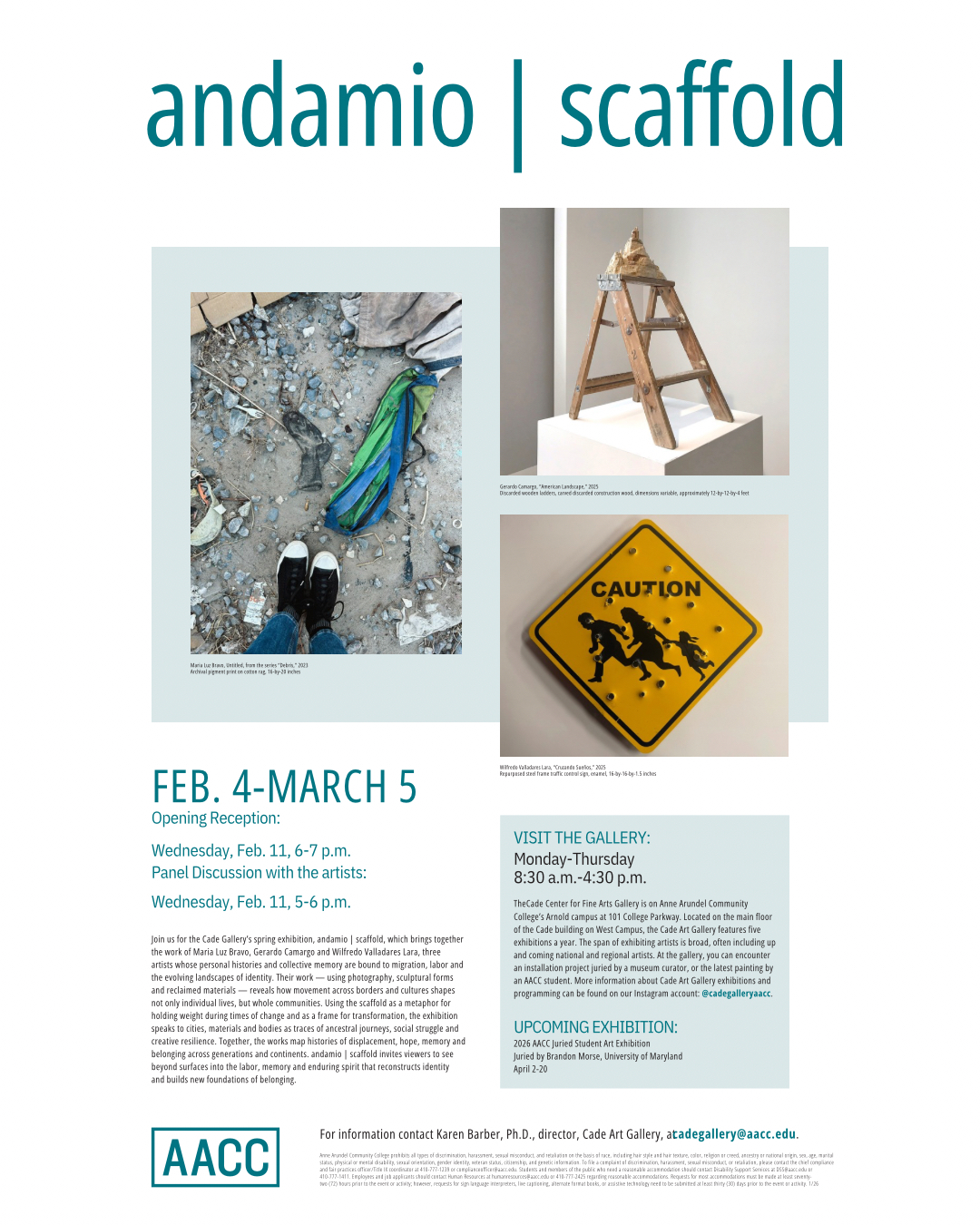
Join us for the Cade Gallery’s spring exhibition, andamio | scaffold, which brings together the work of Maria Luz Bravo, Gerardo Camargo, and Wilfredo Valladares Lara, three artists whose personal histories and collective memory are bound to migration, labor, and the evolving landscapes of identity. Their work—using photography, sculptural forms, and reclaimed materials—reveals how movement across borders and cultures shapes not only individual lives, but whole communities. Using the scaffold as a metaphor for holding weight during times of change and as a frame for transformation, the exhibition speaks to cities, materials, and bodies as traces of ancestral journeys, social struggle, and creative resilience. Together, the works map histories of displacement, hope, memory, and belonging across generations and continents. andamio | scaffold invites viewers to see beyond surfaces—into the labor, memory, and enduring spirit that reconstructs identity and builds new foundations of belonging.
Maria Luz Bravo’s (b. 1975, Mexico) photographs examine the intersections of space, politics, and social resilience. With a background in architecture, her practice explores the urban and architectural landscape as a lens to reveal broader social phenomena, with a focus on cities in conflict, contested political boundaries, and the resilience of communities navigating instability. In keeping with this focus, her recent series, titled “Debris,” captures the detritus—scraps of clothing, utensils, bags, and other necessities—abandoned by immigrants making the perilous passage to the United States. Rejecting a longer view that might situate these discarded objects in a specific location or landscape, Bravo instead turns her camera to the ground where her body is a corporeal reminder that this contested terrain was not always empty, nor was it silent.
Gerardo Camargo, born in Mexico City, explores the use of techniques and discarded materials traditionally used in building construction. In so doing, his work combines abstraction with the aesthetics of American architecture. Rather than making use of pristine materials, Camargo embraces the marks, cuts, scratches, fingerprints, and other evidence of utility and manipulation to speak to the past life and energy—the hidden effects of labor—evident in these objects. In so doing, Camargo creates alternative narratives that foreground the acts carried by bodies in motion, bodies engaged in labor, so often erased in architecture and our built environment. For example, American Landscape combines a paint spattered wooden ladder with carved mountainous form as an evocative reminder of the human toil and labor behind nearly every aspect of the urban landscape.
Artist, educator, and curator, Wilfredo Valladares, originally from Honduras, has built a practice that bridges cultures, histories, and lived experiences. His work has long sought to elevate the voices and cultural narratives of Latinx and Caribbean artists through public cross-cultural initiatives. In his interdisciplinary work, he has consistently brought together unusual materials with themes around memory and migration to create compelling new forms that speak to both personal and broader cultural narratives. In his recent series, created specifically for andamio | scaffold, Valladares uses recycled materials, found objects, and mixed media to examine migration, labor, and political displacement. As in Gerardo Camargo’s work, the materials make visible histories of use, wear, and endurance, reflecting the physical and emotional realities of crossing borders, working in unfamiliar spaces, and living with and in uncertainty. In works like Cruzando Sueños, Valladares draws on a complex interweaving of abstract and representational forms, with layered, often ambiguous meanings that speak to personal and collective narratives shaped by border crossings, deportation, and systems of power. Making use of such disused and overlooked items as water jugs and bullet-ridden street signs, these objects are reframed “as active witnesses to human labor, resilience, and survival.”
Image Credits:
Maria Luz Bravo, Untitled, from the series “Debris,” 2023.
Archival pigment print on cotton rag, 16 x 20 in.
Gerardo Camargo, American Landscape, 2025.
Discarded wooden ladders, carved discarded construction wood,
dimensions variable, approximately 12 x 12 x 4 ft.
Gerardo Camargo, La de la Falda de Serpientes, 2025.
Discarded sandpaper from local construction sites, marble stones, tape roofing felt, and discarded wood, 80 x 45 x 15 in.